Apply Today! Ming Book Course

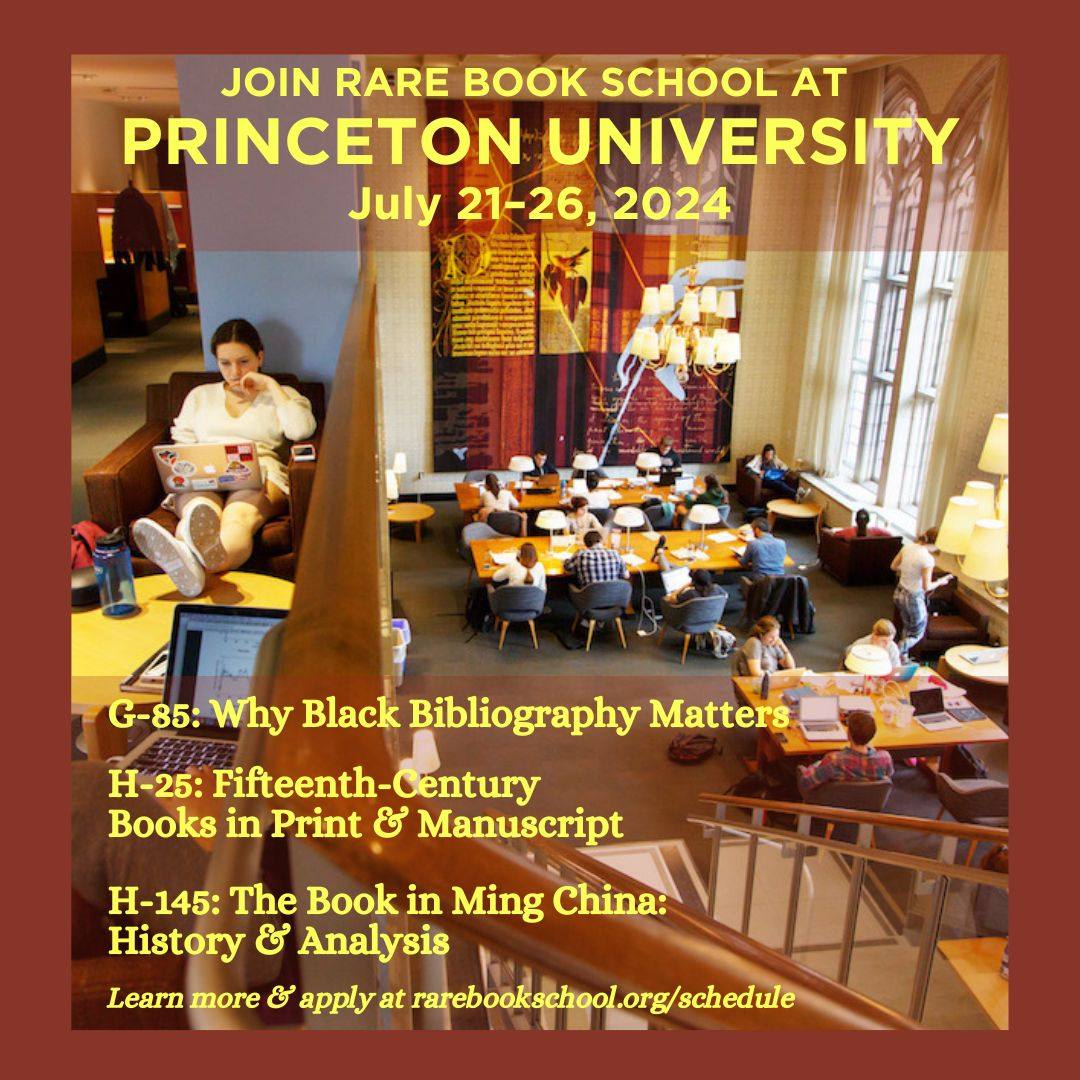
GHF is proud to support The Book in Ming China: History & Analysis, a Rare Book School Course for advanced PhD students to established scholars at Princeton University from July 21 – 26, 2024.

The course will introduce the collection of some 2,000 Ming editions held at the East Asian Library and elsewhere in the Princeton University Library system. Participants will have the chance to investigate opportunities for research in Princeton’s East Asian Rare Books Collection and generate ideas for current and future research projects in Ming Studies.

Tuition is free for admitted students. To be considered for the first round of admissions decisions, apply before February 19.

Take our five-minute survey!

Help the Geiss Hsu Foundation better support scholars like you by taking our brief survey.

Click here to take the survey, and please feel free to share the link with your colleagues. We hope to collect input from a wide range of students, scholars of all levels, and others who work in Ming studies and adjacent fields in the U.S. and abroad.

We deeply appreciate your feedback. Thank you for helping us to advance scholarship of the Ming dynasty!

The Society for Ming Studies Announces Inaugural Geiss-Hsu Book Prize Winners

The Society for Ming Studies’ Geiss-Hsu Book Prize Selection Committee announced that it has awarded the prize for the best overall book in Ming Studies, published between 2019 and 2022, to The Dreaming Mind and the End of the Ming World by Lynn Struve (University of Hawai’i Press, 2019), and the prize for the best first book in Ming Studies, published between 2019 and 2022, to Becoming Guanyin: Artistic Devotion of Buddhist Women in Late Imperial China by Yuhang Li (Columbia University Press, 2019). 

Of Struve’s book, the Selection Committee wrote:

Over the half century, Lynn Struve has worked tirelessly to allow us to hear the voices of the men and women who experienced the cataclysmic events of the fall of the Ming and the establishment of a Manchu regime. Her translations and interpretations have revealed the traumas and joys, the disillusions and hopes, the fears for the future and profound sense of nostalgia of the generations that lived through this period. The Dreaming Mind goes further, by leading us into the minds of Ming intellectuals by way of their dreams. Drawing on a vast range of sources, The Dreaming World demonstrates that in China between the middle of the sixteenth century and the end of the seventeenth, dreams elicited more interest than ever before or after, and quite possibly more than anywhere else at any time in world history. 

During a time of political collapse, environmental crisis, and social disjuncture, scholars turned inwards. Their writings about dreams reveal the ways in which they made sense of their surroundings and experiences, bothas psychological phenomena and as they were cynically or pragmatically deployed. Struve demonstrates brilliantly how dreams served as a coping mechanism in a time of profound distress. Her readings of dream-writings show not only how Ming writers drew on the historical and contemporary cultural repertoires available to them, but how profoundly their intensely personal writings about dreams shaped this period. She makes even quite well-known men look different because of their dreams. In a brief epilogue, Struve reflects on the ways in which the Ming dream world was transformed in the context of the eighteenth-century turn to positivism and text criticism. Dreaming no longer occupied the minds of intellectuals, although it continued to feature in the literary writings about and by women, not least in that most famous of dreams: the mid-eighteenth-century Dream of The Red Chamber (Honglou meng), one of most influential novels in Chinese literature.

In making this award, the Committee presents The Dreaming Mind as a model for scholars. First, in recognizing the need to research the less-rational areas of life that matter so much to people, Struve delved into neuroscience, and she succinctly explains what she learned about brains, before moving on to consider how brains become minds within societies/cultures at historical moments defined by socio-economic trends and political events.  We should feel inspired by her example to learn a bit about whatever fields impinge on the questions we are pursuing.  Second, in writing Struve provides enough background – carefully footnoted even for things that are common knowledge among sinologists, for instance the Donglin/Wei Zhongxian conflict – that novices and non-China scholars will be able to understand the people, the evidence, and the arguments. Third, Struve has mined and engaged with literature, personal narrative, paintings, philosophy, and political texts, with primary and secondary sources in Chinese, English, Japanese, German, and French, such that her Works Cited is forty pages long.  She brings the reading of a lifetime to bear on the topic, contributing along the way to other debates in Ming history, such as the “Three Teachings are One” movement and its co-existence with tensions among Buddhism, Daoism, and Confucianism. Although the necessity for one clear argument is beaten into us by advisors and presses, Struve shows that digressions and complications are a worthy part of scholarship.  Finally, as in her compilation of primary sources Voices from the Ming-Qing Cataclysm: China in Tigers’ Jaws, she provides lively, intensely human biographies of a number of late-Ming elite figures, demonstrating that presenting readable stories is fully compatible with meticulous scholarship. The Committee commends Struve for setting a high standard of scholarship and writing that scholars can all strive to match.

Over the course of her career, Struve has given a great deal to the field of Ming Studies. With this extraordinary book, she transforms what we know about the period by revealing its protagonists’ innermost thoughts and experiences. The Dreaming Mind provides the concrete evidence for what many of us have long suspected: that the Ming was a period like no other, not just in Chinese history but in world history.

Of Li’s book, the Selection Committee wrote:

The book begins with an ostensibly simple question: what did Chinese women during the sixteenth and seventeenth centuries do to express their devotion to Guanyin? The answer takes shape over four main chapters, which build on one another: women expressed their devotion through dance, painting, embroidery, and jewelry. Reading familiar stories and paintings in new ways, bringing largely unknown or inaccessible objects and images to our attention, and combining theories of dance and performance, materiality and technology, and gender and sexuality, Li Yuhang has produced a nuanced and insightful exploration of intimate spheres of Buddhist women’s devotion. 

Becoming Guanyin offers three important new insights. First, it reveals the far-reaching agency of late imperial women as artists and creators, as authors and storytellers, and as believers and religious leaders, contrary to persistent presentations of late Ming gentrywomen as bowing to male, Confucian sources of authority and celebrated only for their chastity and purity. Second, it engages with the oft-repeated descriptions of the late Ming as the period in which the population grew, the economy expanded, and goods circulated more than ever before. Becoming Guanyin reveals what this meant for women: they were able to make use of the wider circulation of texts and images through the growth of print culture and the flow into Ming territories of luxury materials, including silver, gold, and precious stones, to embody and materialize their devotion to Guanyin. Third, it reveals the importance of domestic spaces for the production of art and material culture, the circulation of knowledge, and religious techniques, experiences, and practices for both men and women during the Ming. Beyond those lessons, the delight of this book lies in its eye-popping details, its painstaking argumentation, and the complicated humanity of the families and individuals whom Li investigates through texts, tombs, images, and objects. This handsomely illustrated and engagingly written book will fascinate not only specialists of the Ming period, and late imperial China but anyone interested in religious or gender history in the early modern world. 

The Society for Ming Studies received a project award from the Geiss Hsu Foundation to fund these new book prizes. The Foundation also supported both books: Columbia University Press received a subvention award to support the print publication of Becoming Guanyin, while the University of Hawai’i Press was awarded funds to make The Dreaming Mind open access.

An awards ceremony will be held at the Society for Ming Studies Annual Meeting at the Association for Asian Studies Annual Conference, which takes place March 14 – 17 in Seattle, Washington.

Apply Today! MLA Travel Grant

The Executive Committee of the Ming-Qing Forum of the Modern Languages Association is pleased to announce the Geiss-Hsu Travel Grant to support participation in the 2024 MLA annual convention by scholars of the Ming and adjacent periods. Convention participants (panel presenters, discussants, or organizers) may apply for grants of up to a maximum of $2,000 to reimburse the costs of conference travel, registration, and lodging.

Selection will be based on need, with preference given to graduate studentsjunior faculty, and faculty at institutions that provide limited funding for research travel.

Awards will be announced in early December, with funds provided after the conference. For full consideration, please apply using this link by November 20, 2023. Please direct questions to Rania Huntington: huntington@wisc.edu.

Fall Awards Announcement

The Board of Directors of the Geiss Hsu Foundation is delighted to announce awards made during the fall application cycle. Congratulations to the awardees!

PROJECTS

Books in Ming China, a Rare Book School Course at Princeton

In collaboration with the Princeton University Library, Rare Book School will offer a new course on Books in Ming China as part of the School’s 2024 course roster. Intended for scholars already familiar with Ming studies, this course will introduce participants to the collection of some 2,000 Ming books held at the Princeton libraries. Students will have the chance to conduct research in Princeton’s Gest Collection of East Asian Materials and generate ideas for current and future research projects in Ming Studies.  

Global Voices in Ming Studies: A Roundtable on New Books by International Scholars of the Ming

To support emerging scholars, the Society for Ming Studies will host a roundtable on new books by international Ming scholars at the Society’s meeting-in-conjunction at the Association for Asian Studies Conference in Seattle. Funding from GHF will allow three junior scholars who are based at institutions outside of North America and have recently released books with non-US publishers to travel to the conference to participate in the roundtable.

More UW Press / Geiss Hsu Foundation Open Access Books: Three Translations

University of Washington Press will add three titles to the collection of UW Press / Geiss Hsu Foundation Open Access Books: Jiang Yonglin’s translation of The Great Ming Code / Da Ming lü, first published in 2005; the annotated translation of Further Adventures on the Journey to the West, prepared by Qiancheng Li and Robert Hegel and published in 2020; and the 2021 annotated edition of The Lady of Linshui Pacifies Demons, translated by Kristin Ingrid Fryklund, with an introduction and notes by Mark Edward Lewis and Brigitte Baptandier.

New Approaches to the Study of Traditional Chinese Food Culture: A Workshop

By examining the ways that food and drink shaped, and were shaped by, a wide range of cultural practices in imperial China, the workshop at the University of California, Santa Barbara will highlight the Ming dynasty’s pivotal place in their development. The workshop will also provide a venue for participants to hone their papers prior to submitting them for publication in a special issue of the open-access, peer-reviewed Journal of Chinese History, which will be guest-edited by the workshop’s organizers.

Performance Theory in Early Modern China 

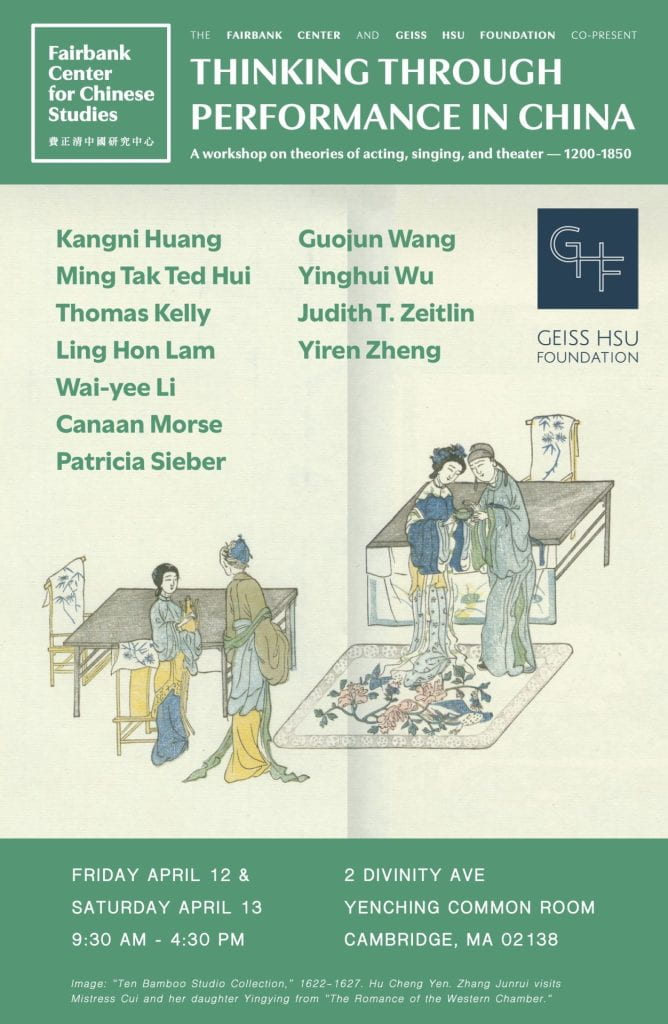
This workshop, which will be held at Harvard University, reconsiders the significance of critical writings about theater and musical performance in early modern China (1500 – 1800). How did artists, intellectuals, and critics reflect on experiences of watching or listening to live performance? How did the act of writing about theatrical spectatorship become an artform in and of itself? What might these texts offer for theater and performance studies across the world today? 

Wulong / Fifth Dragon Conference

An award from GHF will support the SEUSS-FLIC Annual Conference, which will be held at the University of Tennessee, Knoxville from February 23 – 25, 2024. Organized around the theme of “Family, Friendship, and Community,” panel sessions will focus on the benefits of familial and community networks and the tensions that sometimes arose between these relationships and obligations to family, society and the state. Mark Halperin, Professor of Chinese at the University of California, Davis, will give a keynote address.  

SUBVENTIONS

Games and Play in Chinese and Sinophone Culture. Edited by Li Guo, Douglas Eyman, and Hongmei Sun (University of Washington Press, forthcoming May 2024)

The rising scholarly field of game studies examines games as global, interconnected phenomena, but little has been published on the history of games and gaming in China and this volume begins to fill that gap with a perspective that counters Western-focused views of gaming. Among the topics explored in Games and Play are rock carvings of board games, weiqi cultures, scholars’ and courtesans’ games, gambling, games based on literature, internet-game addiction, video-game politics, and the appropriation of Chinese culture in video games.  

More Swindles from the Ming: Scams, Sex, and Sorcery by Zhang Yingyu. Translated by Christopher Rea and Bruce Rusk (Columbia University Press, forthcoming May 2024)

This companion volume to The Book of Swindles: Selections from a Late Ming Collection (Columbia University Press, 2017) translates the remaining 40 stories from A New Book for Foiling Swindlers, Based on Worldly Experience, by Zhang Yingyu, that were not included in the 2017 selection. Together, the two volumes make the entirety of the original book available to an English-speaking audience.

Three Impeachments: Guo Xiu and the Kangxi Court by R. Kent Guy (University of Washington Press, forthcoming October 2024)

Bringing together a rich trove of sources, Three Impeachments traces the process of impeachment, review, condemnation, and restoration to provide unique insights into the Kangxi golden age. Part I reveals that the highly lauded accomplishments of the Kangxi emperor were not his alone, but the result of collaboration between Manchu elite, the newly formed Chinese Martial Banner Army, and Chinese scholars. Part II, which focuses on Guo Xi’s impeachments, sheds new light on dynastic history and political agency. 

Spring Award Selections

The Geiss Hsu Foundation (GHF) is pleased to announce six awards made during the spring application cycle in support of projects that advance scholarship and interpretation of the Ming dynasty and adjacent time periods and peoples.

Arizona State University I Sookja Cho, associate professor of Korean and comparative literature, Arizona State University, with Joonyoun Kim, professor of Chinese language and literature, Korea University

An award supporting Translating the China and East Asian World Portrayed in Choson Korean Literature, an interdisciplinary workshop on China and East Asia in premodern Korean literature, which will take place at Arizona State University on December 8, 2023

China Institute in America

An award supporting the exhibition Treasures for Buddha: The Legendary Offerings from Nanjing Dabao’en Temple at the China Institute Gallery from October 24, 2023 to May 16, 2024, which will showcase objects discovered during the excavations of the Dabao’en Temple in Nanjing 

Modern Language Association of America I Rania Huntington, Executive Committee of the Ming-Qing Chinese Languages, Literature and Culture Forum, Modern Language Association of America

An award supporting membership dues, conference travel, lodging, and registration for at least five scholars of Ming or Ming-adjacent fields to attend the Modern Language Association of America Convention in Philadelphia from January 4-7, 2024

Society for Ming Studies I Thomas Kelly, President, Society for Ming Studies

A three-year award supporting the work of the managing editor of the Journal of the Society for Ming Studies, including funding travel to the Association for Asian Studies Annual Conference

UChicago Global and the University of Chicago Center in Beijing  I Judith Zeitlin, William R. Kenan, Jr. Professor in Chinese Literature, University of Chicago

An award supporting a recording and workshop performance of the opera Ghost Village, based on Liaozhai’s Strange Tales by Pu Songling

Universidad de Granada I Antonio José Mezcua López, Universidad de Granada, with Xiaolin Duan, North Carolina State University

An award supporting an interdisciplinary workshop in January 2024 at Universidad de Granada, Spain, that will bring together experts on West Lake in order to produce the first broad-based, edited volume showcasing West Lake from multiple lenses

National Humanities Center Announces Geiss Hsu Fellow

Congratulations to Xiaolin Duan, associate professor of Chinese history in the Department of History at the North Carolina State University, who has been appointed to the Geiss Hsu Fellowship at the National Humanities Center for the 2023-2024 academic year. During her fellowship, Duan will work on an individual research project titled Three Cities of the Early Modern Pacific: Connections and Conflicts between the Ming Dynasty and the Spanish Empire and will have the opportunity to share ideas in seminars, lectures, and conferences at the Center. 

The National Humanities Center is the world’s only independent institute dedicated exclusively to advanced study in all areas of the humanities. Through its residential fellowship program, the Center provides scholars with the resources necessary to generate new knowledge and to further understanding of all forms of cultural expression, social interaction, and human thought. Through its education programs, the Center strengthens teaching on the collegiate and pre-collegiate levels. Through public engagement intimately linked to its scholarly and educational programs, the Center promotes understanding of the humanities and advocates for their foundational role in a democratic society.