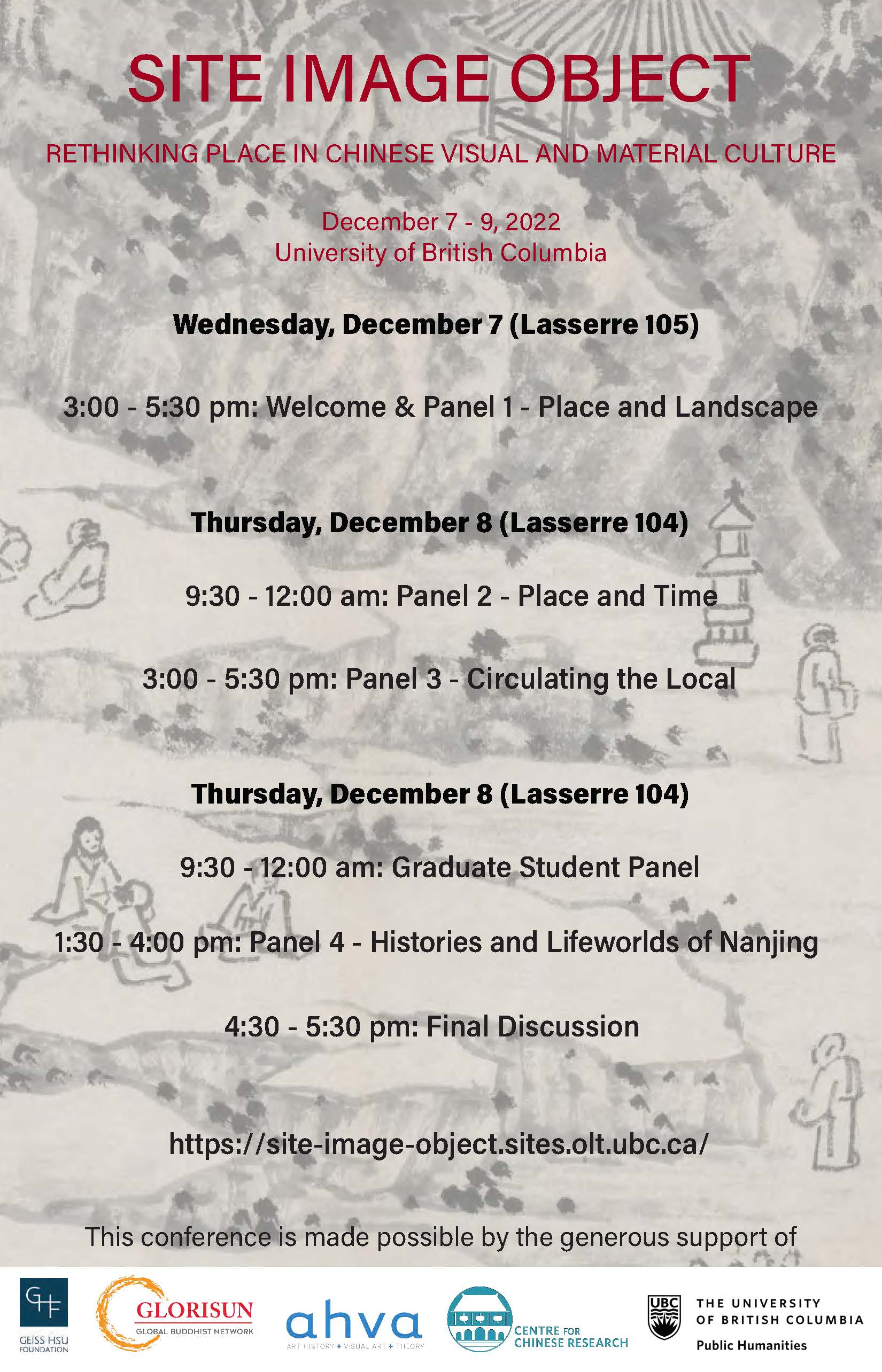
Site-Image-Object: Rethinking Place in Chinese Visual and Material Culture

Conference supported in part by the Geiss Hsu Foundation, University of British Columbia, December 7-9, 2022

“Places are constructed and experienced as material ecological artefacts and intricate networks of social relations. They are the focus of the imaginary, of beliefs, longings, and desires (….). They are an intense focus of discursive activity, filled with symbolic and representational meanings, and they are a distinctive product of institutionalized social and political-economic power.” (David Harvey, Justice, Nature, and the Geography of Difference)

The conference Site-Image-Object: Rethinking Place in Chinese Visual and Material Culture examines how place is shaped by artistic production, and how, at the same time, visual and material expressions shape place and its perception. “Place” here is not an existing given, to which art reacts or that it depicts; rather, we conceive of the interaction between place, its representations, its products, and its architectural framing as a continuously evolving process.

Individual papers address visual representations of place in painting, print, maps, and photography; local products and architectural styles that carry imaginations about their place of origin as they circulate; and sites of religious and cultural significance as agents in artistic production. Considering questions of temporality, narrative, biography, sensory knowledge, remembrance, revival, geographical imagination, networks and circulation, the aim of the conference is to rethink approaches to Chinese landscapes, cityscapes, and religious topography. 

The conference brings together early- and mid-career scholars of Chinese art and culture, whose recent and ongoing work is contributing to a methodological shift in the field as they engage with place. By embracing a long temporal span from the Middle Period to the twenty-first century, the conference facilitates scholarly exchange and collaboration to explore the continuities and discontinuities in Chinese cultural production centred on place as a methodological framework. A graduate student panel provides a platform for emerging voices in the field and offers opportunity for professional development and mentorship.

This in-person conference is free and open to the public but registration is required. Please register here by November 30, 2022. 

New Releases

GHF funding supported these new and forthcoming titles:

Mid-career, senior, and emerging scholars from all areas of the humanities with a strong record of peer-reviewed work are encouraged to apply. In partnership with the James P. Geiss and Margaret Y. Hsu Foundation, the Center welcomes fellowship applications from scholars engaged in the study of early modern China and its world, during and adjacent to the Ming dynasty (1368–1644). 

Scholars from all parts of the globe are eligible; stipends and travel expenses are provided. Fellowship applicants must have a PhD or equivalent scholarly credentials. Fellowships are supported by the Center’s own endowment, private foundation grants, contributions from alumni and friends, and the National Endowment for the Humanities.

Located in the vibrant Research Triangle region of North Carolina, the Center affords access to the rich cultural and intellectual communities supported by the area’s research institutes, universities, and dynamic arts scene. Fellows enjoy private studies, in-house dining, and superb library services that deliver all research materials.

Applications are due by 11:59 p.m. ET, October 6, 2022. For more information and to apply, please visit this link

The National Humanities Center does not discriminate on the basis of race, color, sex, gender identity, religion, national or ethnic origin, handicap, sexual orientation, or age. We are dedicated to fair treatment, diversity, and inclusion.

The National Humanities Center is one of the world’s leading centers for advanced study and the only independent institution of its kind dedicated exclusively to the humanities. For over four decades, the Center has encouraged excellence in scholarship and teaching while constantly affirming the vital importance of the humanities in American life.

Award-Winning Books

Two GHF-funded books were recently recognized for excellence:

Plum Shadows and Plank Bridge: Two memoirs about Courtesans (Columbia University Press, 2020), edited and translated by Wai-yee Li, won the Association for Asian Studies’ Patrick D. Hanan Book Prize for Translation, given biennially to an outstanding English translation of a significant work in any genre originally written in Chinese or an Inner Asian Language, from any time period. 

What the Emperor Built: Architecture and Empire in the Early Ming (University of Washington Press, 2020) by Aurelia Campbell was named honorable mention for the Society for Architectural Historians’ 2022 Alice Davis Hitchcock Book Award for the most distinguished work of scholarship in the history of architecture published by a North American scholar.

Congratulations to Professors Li and Campbell!

Opportunities for Scholars of Early Modern China

Residential Fellowships at the National Humanities Center

The Geiss Hsu Foundation is pleased to announce a three-year partnership with the National Humanities Center to provide residential fellowship support to a scholar of early modern China and its world, beginning with the 2023–24 academic year and concluding in 2025–26. Applications open July 1.

For more information about the partnership and the application process, visit this link.

Spring Awards

The Board of Directors of the Geiss Hsu Foundation is delighted to announce awards made during the spring application cycle. These awards support publications, exhibitions, and conferences that advance scholarship and interpretation of the Ming dynasty and adjacent time periods and peoples.

Project Awards

Zhu Da (1626–1705), Flowers on a River. Qing dynasty. Hand scroll; ink on paper, image size: 18 1/2  × 508 7/8 in. (47 × 1292.5 cm). Collection of the Tianjin Museum

Exhibition

China Institute in America: Flower on a River: The Art of Chinese Flower and Bird Painting, 1368-1911 – Masterworks from Tianjin Museum and Changzhou Museum 

Conferences

University of British Columbia, Centre for Chinese Research: How is China Governed? From Ming Statecraft to Xi’s New Era 

University of British Columbia, Department of Art History, Visual Art & Theory: Site – Image – Object: Rethinking Place in Chinese Visual and Material Culture

Other

Society for Ming Studies: Promoting the Journal of the Society for Ming Studies

Subvention Awards

Open-Access Publishing

Cornell East Asia Series, an imprint of Cornell University Press: Bandits in Print: The Water Margin and the Transformations of Vernacular Fiction by Scott Gregory 

University of Washington Press: Chinese Autobiographical Writing: An Anthology of Personal Accounts, translated by Patricia Buckley Ebrey, Cong Ellen Zhang, and Ping Yao 

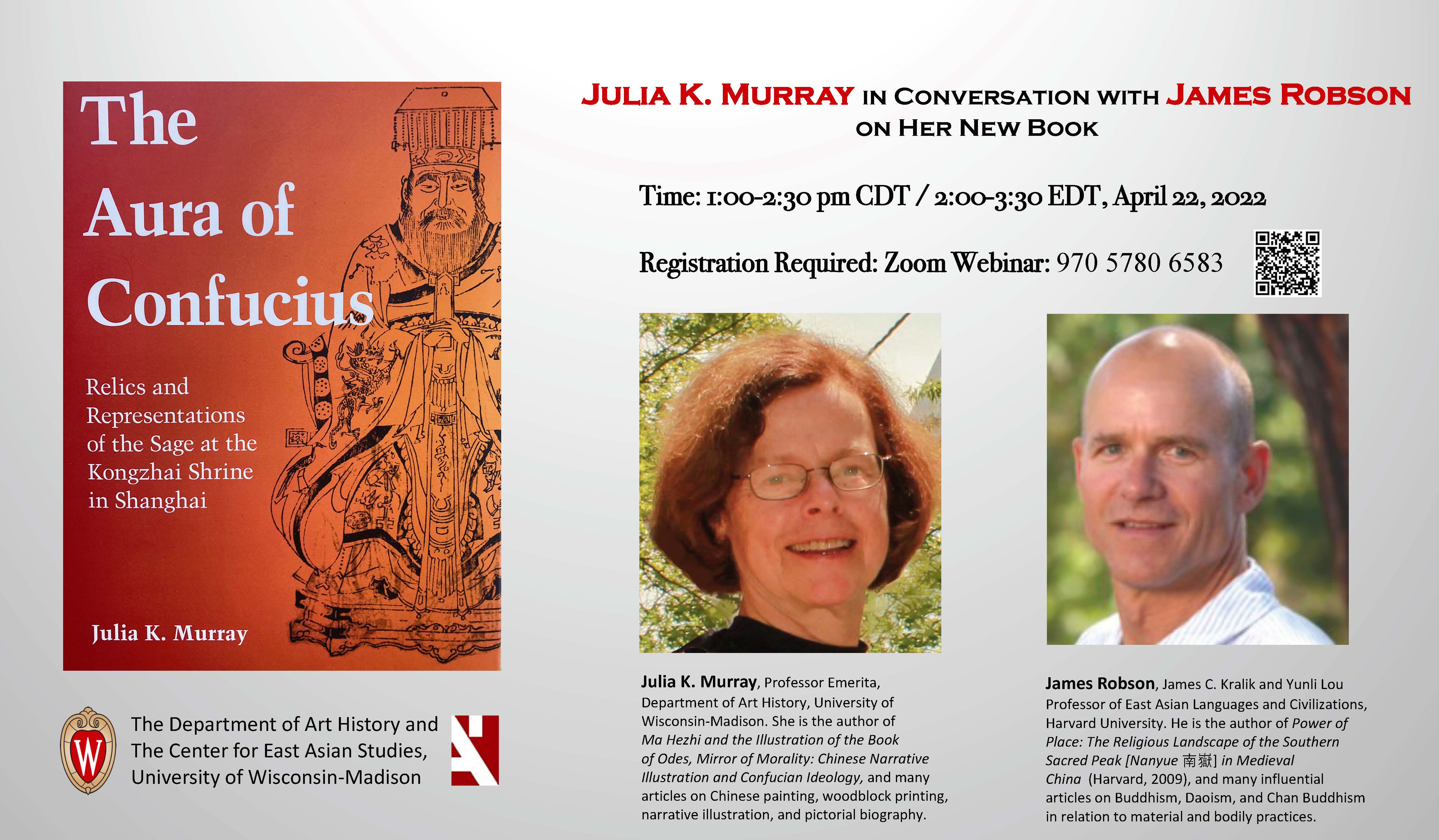
Book Launch for THE AURA OF CONFUCIUS:  Julia K. Murray in conversation with James Robson

The University of Wisconsin-Madison’s Department of Art History and the Center for East Asian Studies are pleased to host an online launch for Julia K. Murray’s new book, The Aura of Confucius: Relics and Representations of the Sage at the Kongzhai Shrine in Shanghai (Cambridge University Press), a conversation between the author and Professor James Robson of Harvard University. A subvention award from the Geiss Hsu Foundation supported this book.

FRIDAY, APRIL 22, 2022  1-2:30 pm (US Central Time)

(11am-12:30pm US Pacific Time / 2-3:30pm US Eastern Time / 7-8:30pm British Time / 8-9:30pm Central Europe Time / 1-2:30am on 4/23 China Time)

Zoom 970 5780 6583

Registration required: https://uwmadison.zoom.us/webinar/register/WN_ZRbf8qAhTxGCPAz_3B9ShA

Facebook Events link: https://fb.me/e/1so1DY9jJ