Call for Applications: Geiss Hsu Foundation Postdoctoral Fellowship in Ming Studies

Application deadline: January 15, 2025

The University of British Columbia (UBC), Vancouver campus, invites applications for the Geiss Hsu Foundation Postdoctoral Fellowship in Ming Studies, starting September 1, 2025. This two-year fellowship will support a scholar in any discipline who studies the Ming Dynasty or a closely-related field, including research that connects the Ming with other time periods and studies of Ming relations with other regions. The fellow will be housed in and supported by the Department of Asian Studies but may be sponsored by a faculty member in any department.

UBC has a long tradition of advanced training in Ming Studies. The China History research cluster hosts a regular work-in-progress series for scholars of Chinese history, which alternates fortnightly with the Ming & More text-reading group that focuses on primary material in Literary Sinitic from the Ming and other periods and regions. The Centre for Chinese Research, part of the Institute for Asian Research, supports interdisciplinary and public-facing scholarship on China.

Fellowship Terms

The fellowship will run from September 1, 2025 to August 31, 2027. The fellow will receive a salary of $80,000 (all amounts in Canadian dollars) and extended health and dental coverage. Up to $5,000 in relocation costs may be reimbursed. The fellow will also have access to $5,000 in research funds each year. No teaching is required, but fellows are eligible to apply to teach one or more courses in a relevant department at UBC. The fellow is expected to give at least one public presentation about their research and to organize a workshop, small conference, or similar event in the second year of the fellowship. Up to $20,000 will be provided to cover the cost of this event. The Centre for Chinese Research will provide workspace and research assistant support.

Click here to learn more and apply!

Fall 2024 Awards

The Board of Directors of the James P. Geiss & Margaret Y. Hsu Foundation is pleased to announce thirteen awards made during the fall application cycle:

SUBVENTIONS

Print & Open Access Publication

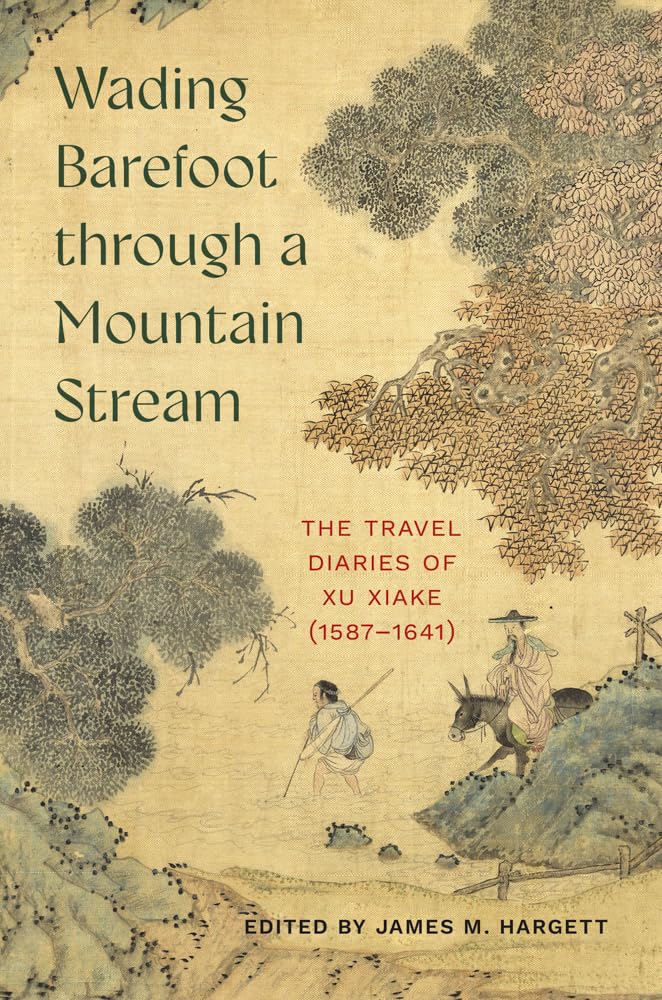
Wading Barefoot through a Mountain Stream: The Travel Diaries of Xu Xiake (1587-1641), James Hargett, lead translator and editor  I University of Washington Press, forthcoming July 2025 

Xu Xiake stands as China’s most distinguished traveler and travel writer, whose extensive journeys through Ming-dynasty China offer a unique window into the era’s geography, history, and cultural traditions. This new, fully annotated English translation includes maps and illustrations, allowing readers to follow Xu’s routes. It will be indispensable for scholars of Chinese history, geography, and travel writing and will bring Xu Xiake’s extraordinary journeys to a broader audience. The award from GHF will support print and open-access editions.

Print Publication

The Woven Image: The Making of Mongol Art in the Yuan Empire by Yong Cho I Yale University Press, forthcoming February 2026

The Woven Image: The Making of Mongol Art in the Yuan Empire paints a drastically different picture of the visual and material worlds of the Mongols in their imperial court. It focuses on fabric images to demonstrate that in the eastern half of their world empire known as the Yuan (1271-1368), the Mongol rulers created a completely new system of the arts. This new system subverted the traditional hierarchies of visual and material arts that had thrived in the various dynasties that previously ruled East Asia. 

PROJECTS

Special Journal Issue

CHINOPERL Anniversary Volume: Music, Language, and Drama in Late Imperial China I Jing Shen, Eckerd College

CHINOPERL is an interdisciplinary and international peer-reviewed journal devoted to Chinese oral and performing literature with authors and readers from all over the world. Revolving around the thread of “music, language, and drama,” articles for this anniversary volume of CHINOPERL delve into collections of arias, qin handbooks, and fragments of play texts from the Ming dynasty and related periods. These musical and literary analyses speak to broader late-imperial intellectual trends, contributing to current scholarly conversations about the subjects.

Conferences

China on the Move: Southeast U.S. Scholars and Friends of Late Imperial China (SEUSS-FLIC) Annual Conference I Dan Du, University of North Carolina at Charlotte

The sixth annual SEUSS-FLIC conference, themed “China on the Move,” will take place at UNC-Charlotte from February 28 – March 1, 2025. It will bring together scholars who study historical exchanges and changes brought by the migration of people, goods, and ideas during the Ming dynasty and beyond. Yuhang Li, associate professor of Chinese art at the University of Wisconsin-Madison and author of the award-winning GHF-funded book Becoming Guanyin: Artistic Devotion of Buddhist Women in Late Imperial China, will give the keynote address.

Echoes of Great Brightness: The Ming Dynasty and Beyond, An International Conference in Honor of Craig Clunas I J.P. Park with Craig Clunas, University of Oxford

Professor Craig Clunas pioneered the application of social history to the study of the Ming dynasty and Chinese art history. His innovative methodology has positioned the study of the Ming dynasty as one of the most dynamic and engaging areas in both art history and sinology. In recognition of his outstanding scholarship, groundbreaking contributions to the field, and his extensive curatorial and academic career, a group of twenty-three scholars are collaborating to present an equal number of papers at Lincoln College, University of Oxford, in fall 2025.

Worlding the Ming Empire in Global Early Modernity  I Xiaoqiao Ling, Arizona State University

This conference, held at Arizona State University from April 4 – 5, 2025, investigates the role of the Ming Empire (1368-1644) as a cultural and geopolitical imaginary that actively contributed to the formation of a textual world during the early modern era (16th-19th centuries). It aims to understand the Ming as a multilayered and co-constructed civilization, along with its participatory role in global early modernity, without casting the empire as a prelude to capitalism, colonization, and globalization. 

Workshops

Manuscript Review Workshop for “The Uses of Anger in Late Imperial Chinese Literature”  I Zhaokun Xin, University of Manchester

Were people in late imperial China angry? Judging from a long-standing scholarly tradition, they were not, but according to this period’s literary productions, they were frequently so. The project proposes to organize a manuscript review workshop in June 2025 for the first dedicated monograph on the understudied representation of anger in late imperial Chinese literature. The Uses of Anger will not only investigate what give rise to the emotion, but also demonstrate how literary works reconfigure the emotion’s regulation in late imperial China.

Mapping the Weird” Manuscript Review Workshop  I Rania Huntington, University of Wisconsin-Madison

This March 2025 workshop will bring together scholars to review Mapping the Weird: the Geography of the Seventeenth Century Strange Tale. Focusing on two understudied tale collections from the early 17th century,  the manuscript combines mapping and geographical analysis with close reading to create an “atlas of the imagination” for the Wanli period (1572-1620), exploring how conceptual maps of the divine and demonic intersect with the maps of administrative, natural, and cultural geography.

Plant Humanities in China  I Natasha Heller, University of Virginia

Using multiple approaches from the humanities to think through a plant’s cultural significance is the work of the nascent subfield of Plant Humanities. This spring 2025 workshop will be an interdisciplinary exploration of what it means to take plants as an organizing focus in the study of Chinese culture. Countering the presentist orientation of much of environmental humanities, the workshop will take a long view of plant studies, with scholars whose work spans from the Song dynasty through the Qing.

Grants, Scholarships, & Fellowships

Geiss Hsu Foundation Postdoctoral Fellowship in Ming Studies  I Bruce Rusk, University of British Columbia

This two-year fellowship at the University of British Columbia (UBC), Vancouver for a recent PhD recipient in Ming studies will allow the fellow to focus on research with a robust community of Ming and Ming-adjacent scholars, an excellent library collection, and strong connections to East Asia. The fellowship will begin on September 1, 2025, and the fellow will give at least one research talk, present at the Ming & More text-reading group, and organize a one-time workshop, small conference, or talk series at UBC on a topic related to Ming studies.

GHF Support for Friends of the Princeton University Library (FPUL) Grants  I Mireille Djenno, Princeton University Library

Funding from GHF will earmark Friends of the Princeton University Library (FPUL) Grants for Ming scholars. During this three-year pilot program, a selection committee will award up to three Ming-focused grants to scholars who wish to conduct research at the Princeton University Library’s Special Collections, including the in the East Asian Library (Gest Collection). These grants, which have a value of up to $6,000 plus transportation costs, are meant to help defray expenses incurred in traveling to and residing in Princeton during the tenure of the grant. 

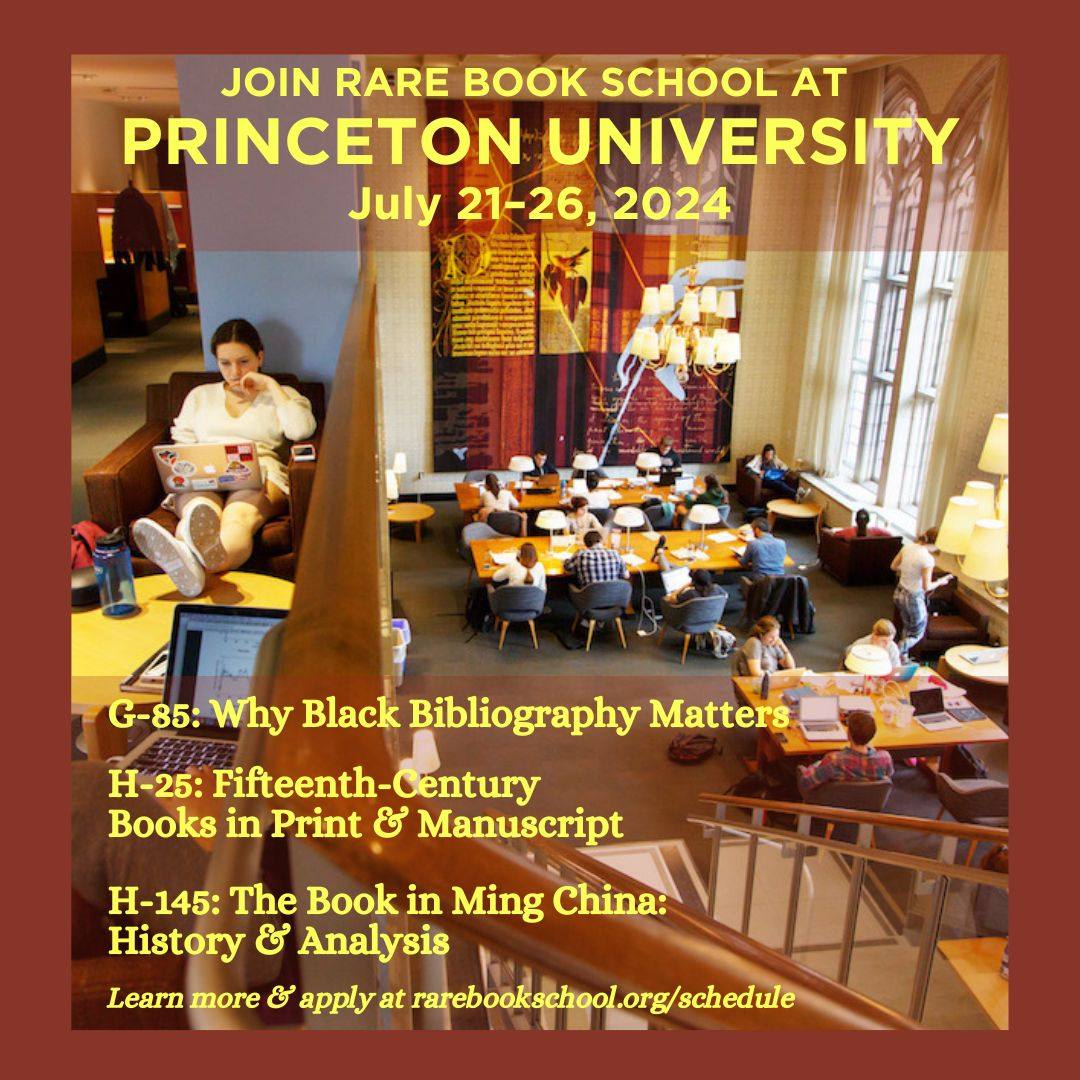
RBS-Geiss Hsu Foundation Scholarships  I Michael Suarez, S.J., Rare Book School

Funding from GHF will support scholarships for students of the history of the book in Asia at Rare Book School(RBS). The Geiss Hsu Scholarships will allow young scholars to pursue learning in areas germane to the study of the book in the greater Ming world, studying with the School’s distinguished international faculty in seminar-style classes. The RBS course week includes academic lectures, discussion forums, demonstrations, exhibitions, and additional opportunities to socialize with students and faculty from early morning through late evening.

Open-Access Platform

Exploring Literati Discourses, 14th– 18th Centuries I Peter Bol, Harvard University

This project will build an open-access public platform, based on Large Language Models and Private Knowledge Bases, with which scholars can explore the collected writings of 325 individuals from the late Yuan to the early Qing found in the Siku quanshu. The user interface will allow researchers and the interested public to investigate topics in Ming history and culture. They will be able to call up documents and have them punctuated, analyzed, and translated, and they will be able to discover who else spoke to those topics.

The Peach Blossom Fan: Theater, Trauma, and Translation

Funded by a project award from the Geiss-Hsu Foundation

The Peach Blossom Fan is one of the most important plays in Chinese history. It is also a masterpiece of world literature, acclaimed for the sophisticated ways it uses the tools of the theater to reflect on historical trauma and memory. Wai-yee Li’s annotated translation renders this vital work newly accessible for students of Chinese history, comparative literature, and theater studies. The first complete English translation of the drama and its paratexts, Professor Li’s new edition builds upon, and synthesizes, her groundbreaking research on gender and trauma, the rhetoric of historiography in the Chinese tradition, and literary responses to the Ming-Qing dynastic transition. The play’s central themes—the relationship between art and violence, the perils of political extremism, and the tensions between historical judgment and memory—still speak to our contemporary moment in urgent and profound ways. This roundtable and reception will celebrate the publication of Professor Li’s new translation, reflecting on the enduring significance of The Peach Blossom Fan, the challenges involved in translating this monumental work, and how the play still resonates with readers around the world today. Panelists will share their thoughts on both the drama and the craft of literary translation in general.    

Location: Harvard-Yenching, 2 Divinity Avenue

Roundtable: December 5, 4:00-5:30 pm 

Welcome and introduction: Tom Kelly (Assistant Professor in EALC, Harvard University)

Responses:

  • Wiebke Denecke (S. C. Fang Professor of Chinese Language and Culture, MIT)
  • Catherine Yeh (Professor of Chinese and Comparative Literature at Boston University)
  • Eileen Cheng-yin Chow (Associate Professor of the Practice of Asian and Middle Eastern Studies, Duke University)
  • Ariel Fox (Associate Professor, East Asian Languages and Civilizations, University of Chicago)
  • Canaan Morse (Postdoc Research Associate and Lecturer at the University of Virginia)
  • Ellen Widmer (Mayling Soong Professor of Chinese Studies & Professor of East Asian Studies, Wellesley College)
  • Wai-yee Li (1879 Professor of Chinese Literature at Harvard University)

Reception: 5:30–7:00 pm (upstairs at 2 Divinity)

New Fellowship Opportunities

GHF is partnering with the National Humanities Center to support residential fellowships for emerging, mid-career, or senior scholars studying China and its world, during and adjacent to the Ming dynasty.

The National Humanities Center welcomes fellowship applications from scholars engaged in the study of China and its world, during and adjacent to the Ming dynasty (1368–1644).

The Center is pleased to announce a five-year partnership with the James P. Geiss and Margaret Y. Hsu Foundation to provide residential fellowship support to a scholar engaged in the study of China in the Ming dynasty (1368–1644), or of regions and time periods adjacent to the Ming, beginning with the 2025–26 academic year.

Established in 2001, the James P. Geiss and Margaret Y. Hsu Foundation encourages and supports scholarly research and interpretation of imperial China during the Ming dynasty (1368–1644), as well as its immediate predecessors and successors, and of contemporaries in geographic areas with which the Ming interacted.

All Fellows are assigned private studies with 24-hour access to the Center’s facilities, enjoy meals prepared by the Center’s dining staff, and receive the support of the Center’s dedicated librarians. They may also take part in scholarly colloquia, reading groups, and social activities with other leading scholars from around the world. More information can be found on our Frequently Asked Questions page.

Emerging scholars, mid-career scholars, and senior scholars may apply for a residential fellowship for the fall semester (September through December), spring semester (January through May), or academic year (September through May). Interested scholars must apply directly to the Center via their online system. This year, the residential fellowship competition opens on July 1 and closes on October 3, 2024. Please check the program page for information regarding the Center’s online application, services, and support.

Spring Award Winners

The Board of Directors of the James P. Geiss & Margaret Y. Hsu Foundation is pleased to announce three awards made during the spring application cycle:

SUBVENTIONS

The Empress and the Dragon Throne: Women in the Imperial Family in the First Hundred Years of China’s Ming Dynasty by Ellen Soulliere I Hong Kong University Press, forthcoming spring 2025 

The first of three planned volumes spanning the entire Ming dynasty, the book examines the social, political, economic, and cultural hierarchies, rituals, and codes of behavior that defined and protected the status of women within the family and the household during the early Ming dynasty. Richly informed by evidence from texts and material culture, it analyses and interprets women’s contributions to the many successes and the eventual failure of the dynasty and the state.

Forger’s Creed by J.P. Park I University of California Press, forthcoming spring 2025

Forger’s Creed examines how and why numerous fake texts, forged paintings, and bogus art theories were fabricated in the late Ming and early Qing periods. Investigating the forgeries as sites of conflict and negotiation in the production and consumption of art invisibly shared between different social groups, Park considers the establishment of a refined and elegant public sphere under the rubric of “legitimate lineage” as an attempt by elites to regulate public discourse on art. 

PROJECT

Project Planning for “The Workers of the Ming World and Their Sources” I University of Warwick, PI: Anne Gerritsen (Warwick), with Sarah Schneewind (UC San Diego)

The award will support in-person and online project planning meetings for a workshop presenting transformative research on the “lesser relations” of the Ming world—brokers, merchants and shopkeepers; accountants and scribes; clerks and runners; gatekeepers and doormen; clergy; boatmen, porters, grooms, and sedan-chair carriers—who played key roles in shaping social and knowledge structures. The planners aim to organize the workshop for 2025 and to publish papers in 2026.

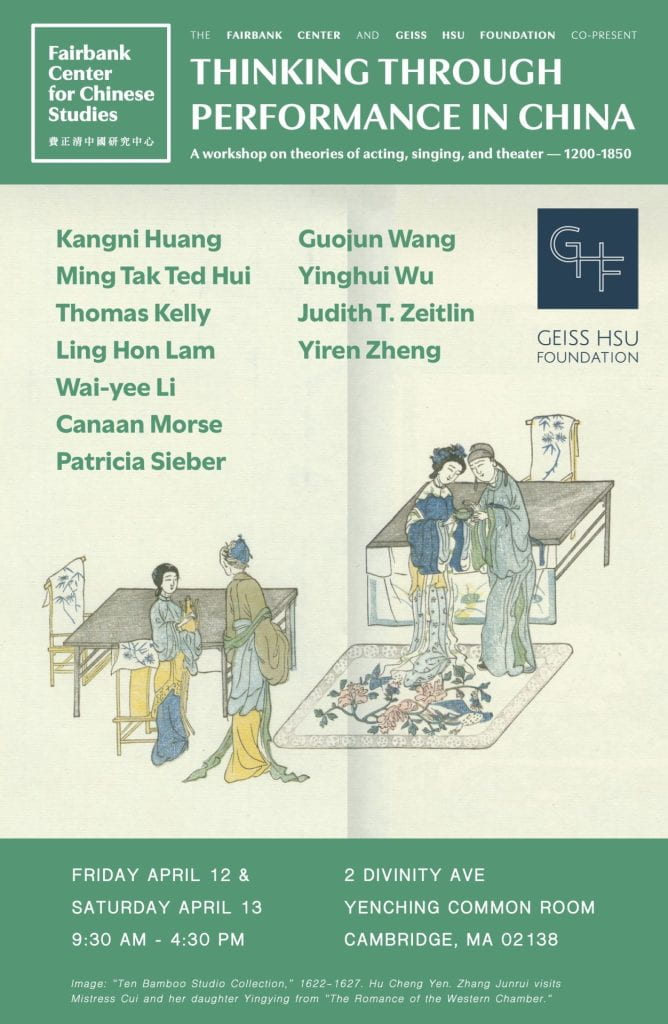
Thinking Through Performance in China

April 12 & 13, 2024, 9:30 a.m. to 4:30 p.m.

2 DIVINITY AVE
YENCHING COMMON ROOM
CAMBRIDGE, MA 02138

This GHF-funded workshop reconsiders the significance of critical writings about acting, singing, and theatrical performance in China (c.1200–1850). How did artists, intellectuals, and critics reflect on experiences of watching or listening to live performance? How did the act of writing about spectatorship become an artform in and of itself? What might these texts offer for theater and performance studies across the world today? The central question these texts address —namely, “what is the function of Chinese theater?”—has ramifications for students of Chinese history, literature, and thought more broadly.

Click here for more information and the full workshop schedule.

Apply Today! Ming Book Course

GHF is proud to support The Book in Ming China: History & Analysis, a Rare Book School Course for advanced PhD students to established scholars at Princeton University from July 21 – 26, 2024.

The course will introduce the collection of some 2,000 Ming editions held at the East Asian Library and elsewhere in the Princeton University Library system. Participants will have the chance to investigate opportunities for research in Princeton’s East Asian Rare Books Collection and generate ideas for current and future research projects in Ming Studies.

Tuition is free for admitted students. To be considered for the first round of admissions decisions, apply before February 19.

Take our five-minute survey!

Help the Geiss Hsu Foundation better support scholars like you by taking our brief survey.

Click here to take the survey, and please feel free to share the link with your colleagues. We hope to collect input from a wide range of students, scholars of all levels, and others who work in Ming studies and adjacent fields in the U.S. and abroad.

We deeply appreciate your feedback. Thank you for helping us to advance scholarship of the Ming dynasty!

The Society for Ming Studies Announces Inaugural Geiss-Hsu Book Prize Winners

The Society for Ming Studies’ Geiss-Hsu Book Prize Selection Committee announced that it has awarded the prize for the best overall book in Ming Studies, published between 2019 and 2022, to The Dreaming Mind and the End of the Ming World by Lynn Struve (University of Hawai’i Press, 2019), and the prize for the best first book in Ming Studies, published between 2019 and 2022, to Becoming Guanyin: Artistic Devotion of Buddhist Women in Late Imperial China by Yuhang Li (Columbia University Press, 2019). 

Of Struve’s book, the Selection Committee wrote:

Over the half century, Lynn Struve has worked tirelessly to allow us to hear the voices of the men and women who experienced the cataclysmic events of the fall of the Ming and the establishment of a Manchu regime. Her translations and interpretations have revealed the traumas and joys, the disillusions and hopes, the fears for the future and profound sense of nostalgia of the generations that lived through this period. The Dreaming Mind goes further, by leading us into the minds of Ming intellectuals by way of their dreams. Drawing on a vast range of sources, The Dreaming World demonstrates that in China between the middle of the sixteenth century and the end of the seventeenth, dreams elicited more interest than ever before or after, and quite possibly more than anywhere else at any time in world history. 

During a time of political collapse, environmental crisis, and social disjuncture, scholars turned inwards. Their writings about dreams reveal the ways in which they made sense of their surroundings and experiences, bothas psychological phenomena and as they were cynically or pragmatically deployed. Struve demonstrates brilliantly how dreams served as a coping mechanism in a time of profound distress. Her readings of dream-writings show not only how Ming writers drew on the historical and contemporary cultural repertoires available to them, but how profoundly their intensely personal writings about dreams shaped this period. She makes even quite well-known men look different because of their dreams. In a brief epilogue, Struve reflects on the ways in which the Ming dream world was transformed in the context of the eighteenth-century turn to positivism and text criticism. Dreaming no longer occupied the minds of intellectuals, although it continued to feature in the literary writings about and by women, not least in that most famous of dreams: the mid-eighteenth-century Dream of The Red Chamber (Honglou meng), one of most influential novels in Chinese literature.

In making this award, the Committee presents The Dreaming Mind as a model for scholars. First, in recognizing the need to research the less-rational areas of life that matter so much to people, Struve delved into neuroscience, and she succinctly explains what she learned about brains, before moving on to consider how brains become minds within societies/cultures at historical moments defined by socio-economic trends and political events.  We should feel inspired by her example to learn a bit about whatever fields impinge on the questions we are pursuing.  Second, in writing Struve provides enough background – carefully footnoted even for things that are common knowledge among sinologists, for instance the Donglin/Wei Zhongxian conflict – that novices and non-China scholars will be able to understand the people, the evidence, and the arguments. Third, Struve has mined and engaged with literature, personal narrative, paintings, philosophy, and political texts, with primary and secondary sources in Chinese, English, Japanese, German, and French, such that her Works Cited is forty pages long.  She brings the reading of a lifetime to bear on the topic, contributing along the way to other debates in Ming history, such as the “Three Teachings are One” movement and its co-existence with tensions among Buddhism, Daoism, and Confucianism. Although the necessity for one clear argument is beaten into us by advisors and presses, Struve shows that digressions and complications are a worthy part of scholarship.  Finally, as in her compilation of primary sources Voices from the Ming-Qing Cataclysm: China in Tigers’ Jaws, she provides lively, intensely human biographies of a number of late-Ming elite figures, demonstrating that presenting readable stories is fully compatible with meticulous scholarship. The Committee commends Struve for setting a high standard of scholarship and writing that scholars can all strive to match.

Over the course of her career, Struve has given a great deal to the field of Ming Studies. With this extraordinary book, she transforms what we know about the period by revealing its protagonists’ innermost thoughts and experiences. The Dreaming Mind provides the concrete evidence for what many of us have long suspected: that the Ming was a period like no other, not just in Chinese history but in world history.

Of Li’s book, the Selection Committee wrote:

The book begins with an ostensibly simple question: what did Chinese women during the sixteenth and seventeenth centuries do to express their devotion to Guanyin? The answer takes shape over four main chapters, which build on one another: women expressed their devotion through dance, painting, embroidery, and jewelry. Reading familiar stories and paintings in new ways, bringing largely unknown or inaccessible objects and images to our attention, and combining theories of dance and performance, materiality and technology, and gender and sexuality, Li Yuhang has produced a nuanced and insightful exploration of intimate spheres of Buddhist women’s devotion. 

Becoming Guanyin offers three important new insights. First, it reveals the far-reaching agency of late imperial women as artists and creators, as authors and storytellers, and as believers and religious leaders, contrary to persistent presentations of late Ming gentrywomen as bowing to male, Confucian sources of authority and celebrated only for their chastity and purity. Second, it engages with the oft-repeated descriptions of the late Ming as the period in which the population grew, the economy expanded, and goods circulated more than ever before. Becoming Guanyin reveals what this meant for women: they were able to make use of the wider circulation of texts and images through the growth of print culture and the flow into Ming territories of luxury materials, including silver, gold, and precious stones, to embody and materialize their devotion to Guanyin. Third, it reveals the importance of domestic spaces for the production of art and material culture, the circulation of knowledge, and religious techniques, experiences, and practices for both men and women during the Ming. Beyond those lessons, the delight of this book lies in its eye-popping details, its painstaking argumentation, and the complicated humanity of the families and individuals whom Li investigates through texts, tombs, images, and objects. This handsomely illustrated and engagingly written book will fascinate not only specialists of the Ming period, and late imperial China but anyone interested in religious or gender history in the early modern world. 

The Society for Ming Studies received a project award from the Geiss Hsu Foundation to fund these new book prizes. The Foundation also supported both books: Columbia University Press received a subvention award to support the print publication of Becoming Guanyin, while the University of Hawai’i Press was awarded funds to make The Dreaming Mind open access.

An awards ceremony will be held at the Society for Ming Studies Annual Meeting at the Association for Asian Studies Annual Conference, which takes place March 14 – 17 in Seattle, Washington.

Apply Today! MLA Travel Grant

The Executive Committee of the Ming-Qing Forum of the Modern Languages Association is pleased to announce the Geiss-Hsu Travel Grant to support participation in the 2024 MLA annual convention by scholars of the Ming and adjacent periods. Convention participants (panel presenters, discussants, or organizers) may apply for grants of up to a maximum of $2,000 to reimburse the costs of conference travel, registration, and lodging.

Selection will be based on need, with preference given to graduate studentsjunior faculty, and faculty at institutions that provide limited funding for research travel.

Awards will be announced in early December, with funds provided after the conference. For full consideration, please apply using this link by November 20, 2023. Please direct questions to Rania Huntington: huntington@wisc.edu.