By Type
ALL
Digital
Education
Fellowships
Open-Access
Performances
Publications
Travel
Conferences
Workshops
Exhibitions
Other
By Year
2023
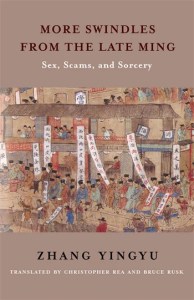
More Swindles from the Late Ming: Scams, Sex, and Sorcery
By Zhang Yingyu. Translated by Christopher Rea and Bruce Rusk
Columbia University Press, November 2024

This companion volume to The Book of Swindles: Selections from a Late Ming Collection presents sensational stories of scams that range from the ingenious to the absurd to the lurid, many featuring sorcery, sex, and extreme violence. Together, the two volumes represent the first complete translation into any language of a landmark Chinese anthology, making an essential contribution to the global literature of trickery and fraud. An introduction explores the geography of grift, the role of sex and family relations, and the portrayal of Buddhist clergy and others claiming supernatural powers. Opening a window onto the colorful world of crime and deception in late imperial China, this book testifies to the enduring popularity of stories about scoundrels and their schemes.
2023
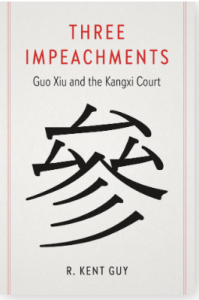
Three Impeachments: Guo Xiu and the Kangxi Court
By R. Kent Guy
University of Washington Press, forthcoming October 2024

Bringing together a rich trove of sources, Three Impeachments traces the process of impeachment, review, condemnation, and restoration to provide unique insights into the Kangxi golden age. Part I reveals that the highly lauded accomplishments of the Kangxi emperor were not his alone, but the result of collaboration between Manchu elite, the newly formed Chinese Martial Banner Army, and Chinese scholars. Part II, which focuses on Guo Xi’s impeachments, sheds new light on dynastic history and political agency.
2022
Remapping the World in East Asia: Toward a Global History of the “Ricci Maps”
Edited by Mario Cams and Elke Papelitzky
University of Hawai’i Press, February 2024

When European missionaries arrived in East Asia in the sixteenth century, they entered ongoing conversations about cosmology and world geography. Soon after, intellectuals in Ming China, Edo Japan, and Joseon Korea selectively encompassed elements of the late Renaissance worldview, leading to the creation of new artifacts that mitigated old and new knowledge in creative ways. Simultaneously, missionaries and their collaborators transcribed, replicated, and recombined from East Asian artifacts and informed European audiences about the newly discovered lands known as the “Far East.” This book rewrites the narrative surrounding the so-called “Ricci Maps,” displacing the European missionary and “his map” as central actors that supposedly bridged a formidable civilizational divide between Europe and China.
2022
The Cornucopian Stage: Performing Commerce in Early Modern China
By Ariel Fox
Asia Center Publications Program, Harvard University, September 2023

In The Cornucopian Stage, Ariel Fox examines a body of influential yet understudied plays by a circle of Suzhou playwrights who enlisted the theatrical imaginary to very different ends. In plays about long-distance traders and small-time peddlers, impossible bargains and broken contracts, strings of cash and storehouses of silver, the Suzhou circle placed commercial forms not only at center stage but at the center of a new world coming into being. Here, Fox argues, the economic character of early modern selfhood is recast as fundamentally productive—as the basis for new subject positions, new kinds of communities, and new modes of art.
2022
The Inscription of Things: Writing and Materiality in Early Modern China
By Thomas Kelly
Columbia University Press, November 2023

Kelly develops a new account of the relationship between Chinese literature and material culture by examining inscribed objects from the late Ming and early to mid-Qing dynasties. He considers how the literary qualities of inscriptions interact with the visual and physical properties of the things that bear them. Kelly argues that inscribing an object became a means for authors to grapple with the materiality and technologies of writing. Facing profound social upheavals, from volatility in the marketplace to the violence of dynastic transition, writers turned to inscriptions to reflect on their investments in and dependence on the permanence of the written word.
2022
The Precious Summary: A History of the Mongols from Chinggis Khan to the Qing Dynasty
By Sagang Sechen, translated by Johan Elverskog
Columbia University Press, forthcoming March 2023

The Mongols are famous on account of Chinggis Khan and the empire they built and ruled in the thirteenth and fourteenth centuries. Yet, what became of the Mongols after the glories of the empire? This is the history that Sagang Sechen relates in the Precious Summary, which was written in 1662, shortly after the Mongols’ submission to the Manchu Qing dynasty (1644-1912). The Precious Summary offers an unparalleled historical perspective on what happened in China and Inner Asia from the late fourteenth century to the founding of the Qing dynasty in the early seventeenth century.
2022
Towers in the Void: Li Yu and Early Modern Chinese Media
By S.E. Kile
Columbia University Press, forthcoming July 2023

Towers in the Void analyzes the contents, format, and circulation of books in the late Ming and early Qing and explores how they functioned to connect readers to one another and to the material world. Kile uses the analytic of media to consider writing and materiality together, thereby elucidating issues as varied as spatial ideology, performance practices, gender roles, and the genre of short vernacular fiction. Kile argues that Li Yu’s idiosyncratic magnum opus, Xianqing ouji (Leisure Notes) was a unique literary form that he forged by combining his expertise in a variety of fields with his interest in generic and stylistic experimentation. Although Leisure Notes has often used by historians as a core source on many topics, no one has considered this pivotal text as a composite whole.
2021
A Ming Confucian’s World: Selections from Miscellaneous Records from the Bean Garden
By Lu Rong, translated and introduced by Mark Halperin
University of Washington Press, forthcoming April 2022

On the eve of the sixteenth-century economic transformation and the age of exploration that was to propel China into the modern world, the scholar-official Lu Rong (1436-94) recorded his observations of contemporary society in Miscellaneous Records from the Bean Garden. Within its genre, Bean Garden is unusual in its author’s willingness to express admiration, frustration, and outrage toward his subjects. Mark Halperin has selected about a quarter of the pieces from the original work, arranging them in topical categories that provide a richly textured first-hand observation of late imperial China designed for course use with undergraduates.